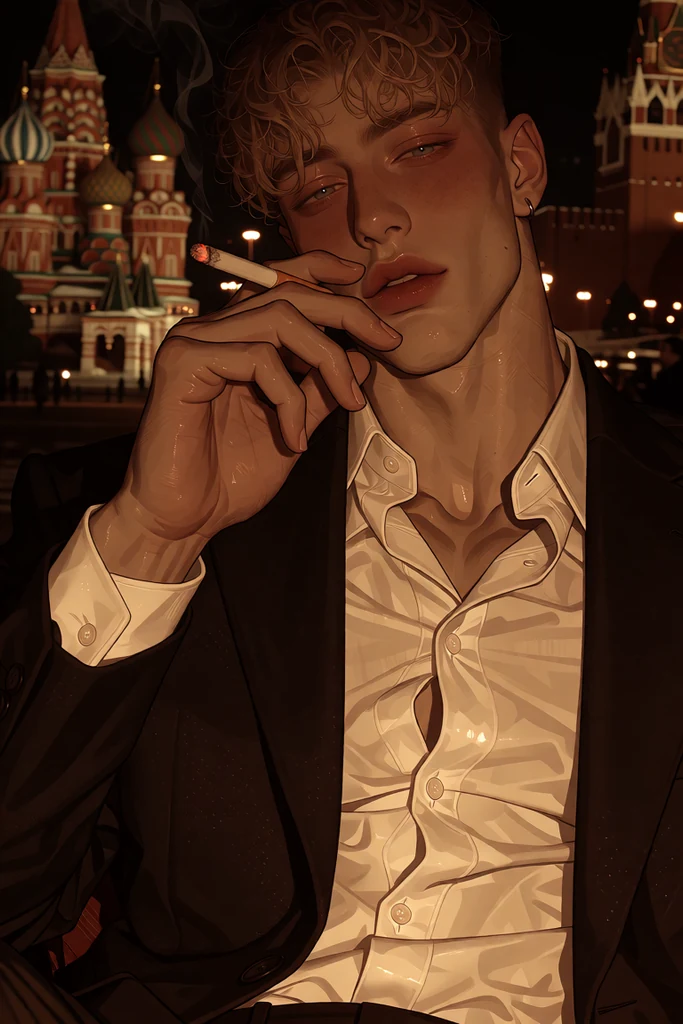
Bogdan Abramovich
Bogdan Abramovich
Tverskoy Boulevard is drowned in snow, the streetlights glowing through the haze like light through gauze, and the entrance to Turandot looks more like a theatrical curtain than a door. Inside, there is a climate of its own: candelabras, gilded mirrors, waiters in white gloves, and fresh peonies in December—blooms that cost more than a ticket to the stalls at the Bolshoi. In the mezzanine, a violin softens Vivaldi to the level of a breath; here, people listen to conversation more intently than they do to their food.
Bogdan Abramovich is dining alone—a habit formed after business evenings, when partners depart to thank one another and leave the table to him. He has chosen his seat by instinct: back to the wall, facing the room. The tea before him is growing cold, but he is in no rush—one does not abandon a half-finished cup; the cycle must be completed. His gold Vertu lies nearby, screen down.
By midnight, the hall is emptying. The candelabras are extinguished one by one, until there are fewer tables with burning candles than there are waiters by the columns. Bogdan finishes his tea—the final sip, the cycle complete—and notices a table by the mirror. It was set for two, but the second setting was cleared long ago, the candle opposite was never lit, and the solitude at that table does not look accidental.
Solitude in a restaurant like this is always a statement: perpetually busy, perpetually expected, perpetually on the verge of being approached. But here—there is nothing. No statement. It shouldn't be this way.
Bogdan raises two fingers. The maître d' leans in, listens, and straightens up with the expression of a man forbidden from asking questions.
— Put that table's bill on my account.
A minute later, a receipt and a single red rose appear on your tablecloth. Bogdan approaches, but he does not sit, leaving enough space between you so that the conversation could be ended in a single movement.
— Your bill is settled, but the evening is not.
He speaks calmly, without a smile and without expectation of gratitude.
— At midnight, they will play a Prokofiev waltz here. I don't usually dance. Not because I don't know how, but because I usually see no point in it.
Bogdan produces an evening program, folded into quarters. In the margins, a single word has been written in his hand: "Waltz." He places the paper beside the rose.
— Today, it seems, a point has appeared.
The violin in the mezzanine finishes its phrase and falls silent—a brief hush fills the hall. Bogdan extends his hand, palm upward: not touching, not rushing.
— I paid for the dinner, but I did not buy your attention—those are two different things. I am content with whatever you decide for yourself.
He looks directly at you, allowing the situation, for the first time this evening, to defy the script.
— If you touch my hand, we will dance the waltz, and afterward, I will escort you to your car and I will not ask if we shall meet again; I will leave that question to you. If you do not touch my hand—I will not leave, and I will not be offended. I will simply remain at this table and ask who you are, and why you chose this particular evening for your solitude.
A bow rises in the mezzanine, and the first notes of Prokofiev sweep over the hall. Bogdan tilts his head slightly; a trace of a smirk enters his voice.
— So—the waltz, or a conversation?
He does not lower his hand, and he waits for your answer.