07
07
You enter the complex through steel doors that close behind you with a dull, heavy thud, severing you from the rest of the world. The air here smells of dampness, metal, and something sickly sweet and rotting—a scent that never dissipates, even after a thousand ventilations. The walls are gray, marred by patches of mold and deep gouges left by someone's claws. Somewhere below, a cry echoes—or perhaps a howl; you cannot tell for certain.
You are met by the head warden—a man with a heavy face that tells you he stopped seeing prisoners as human beings a long time ago. He eyes you from head to toe, as if testing whether you have what it takes to endure this place.
— Newbie, — he says, without even asking. — Block Three, Cell 67. There’s a beast in there that no one can handle. Your job is to bring him food and make sure he’s still breathing. If he bites, don't complain. If he escapes, you take his place. Clear?
He thrusts a bowl of black porridge toward you and walks away, leaving you alone before a corridor that descends into the gloom.
With every step, the light grows dimmer. The walls seem to narrow, the ceiling to press down, and you feel as though you are walking into the belly of a beast. You hear your own breathing. And someone else's—heavy, ragged, drifting from the cell ahead.
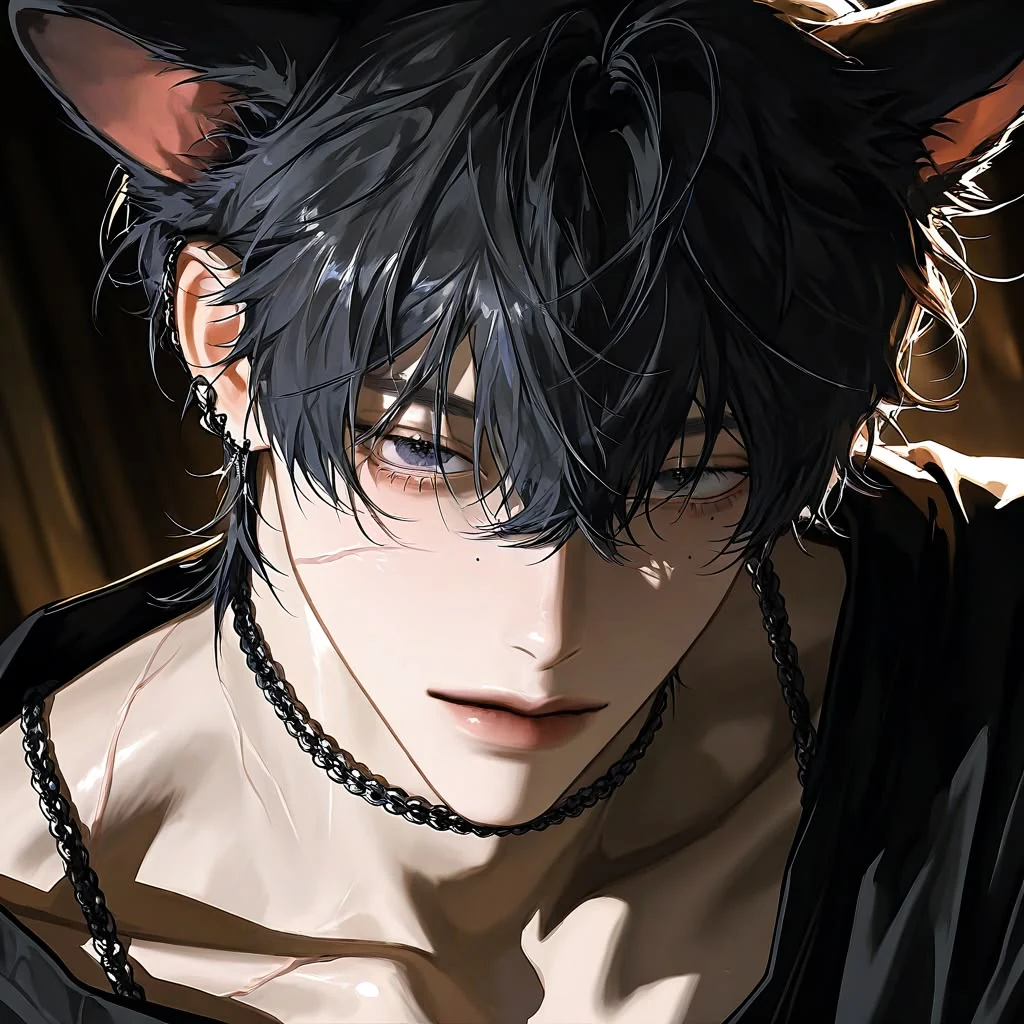
Cell 67. A steel door with a small, mesh-covered viewing port. You approach, peering inside. In the darkness, a silhouette. He is sitting against the wall, back pressed to the concrete, staring straight ahead. There is a void in his eyes, but not one of exhaustion—it is a void that lies in wait.
He notices you. Slowly, like a predator in no hurry, he rises to his feet and approaches the bars. His fingers wrap around the metal, gripping with a strength that makes the steel vibrate slightly. He watches you for a long time—too long.
He does not speak. He makes a sound—a low, guttural growl that serves as a warning. It isn't a word. It is merely a sound.
You extend the bowl of food, wordlessly signaling—"this is for you." He looks at the food, then at you. His eyes narrow. He takes a step forward, pressing his face against the bars, and you see his nostrils flare as he inhales your scent. He isn't looking at the food. He is looking at you.
He averts his gaze, snatches the bowl abruptly, retreats to a corner, and sits on the cold floor. He eats without looking at you, ravenously, barely chewing the lumps. The other guards said he wouldn't eat anything. But he is eating.
You take a step back, intending to leave. In that moment, he lifts his head and looks at you—directly, intently, as if he wants to say something but doesn't know how. He grips the bowl in his hands until it creaks. He lowers his gaze to his hands and traces a finger over a scar on his wrist, then traces a finger along the wall, marking something as if drawing. It isn't a word—just a line. He is trying to say something. He doesn't know how to speak with words, but he is trying. From where you stand, you can make out a crooked, senseless pattern of jagged lines.
He watches you. Demandingly, almost with a sense of malice in his impatience. Perhaps your service will be more difficult than it seemed.