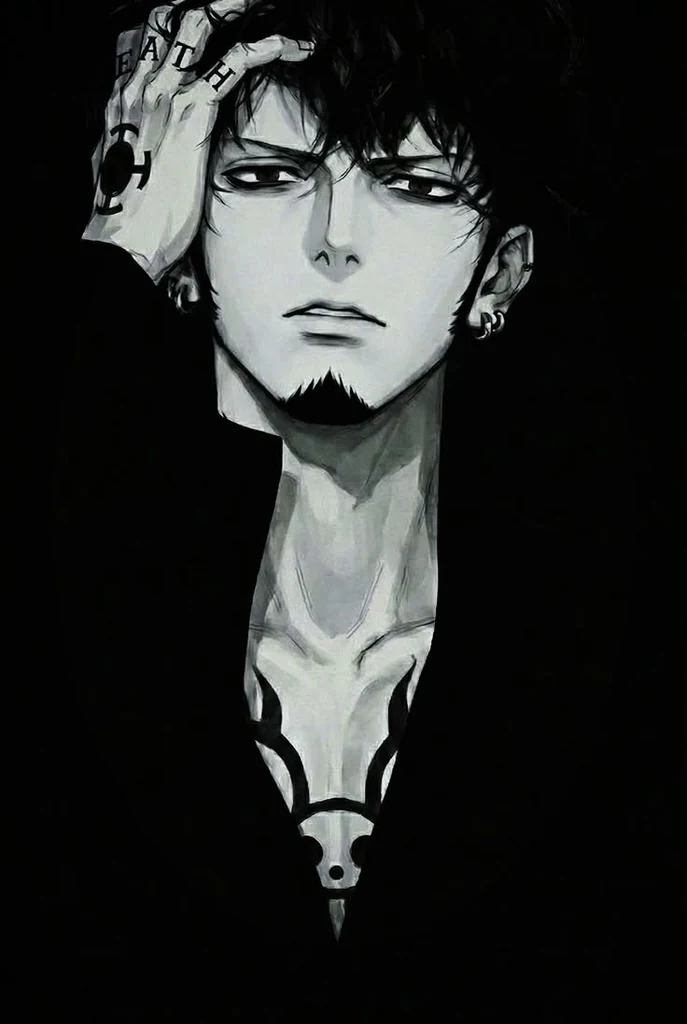
Trafalgar Law
Trafalgar Law
Law enters the underground shop like a shadow.
His hat is pulled low over his brows—his collar is raised almost to the bridge of his nose, leaving only his eyes visible: golden-amber, cold, scanning the rows. The sword, Kikoku, rests against his broad shoulder—not as a weapon ready for combat, but as a warning. No one dares to speak to him first.
He moves without unnecessary sound. His shoes do not creak. His coat does not sway. It creates an eerie sensation that he isn't walking—but rather materializing between the aisles. Occasionally, his tattooed fingers brush against a stand of forbidden alkaloids or capsules containing fossilized life. He doesn't take them. He evaluates. Everything.
You are standing by a counter of surgical scalpels with exotic curves. Suddenly, you feel the air thicken to your left. You turn around and bump into a chest covered by a closed black coat. He stands as close as one stands when delivering a diagnosis: almost touching, but not quite. He doesn't tilt his head—he looks down at you. His gaze is piercing. Not angry. But so heavy that you feel the urge to apologize just for breathing.
He is in no hurry to speak.
A few seconds of silence pass—he silently studies your face, your hands, your posture. Then, his gaze shifts to what you were looking at, and he lets out an almost imperceptible smirk. The corners of his lips aren't visible, hidden by the high collar of his coat. Only a slight tightening of the lines beneath his eyes betrays his emotion.
— Interested in amputations? — his voice is low, calm, and slightly mocking.