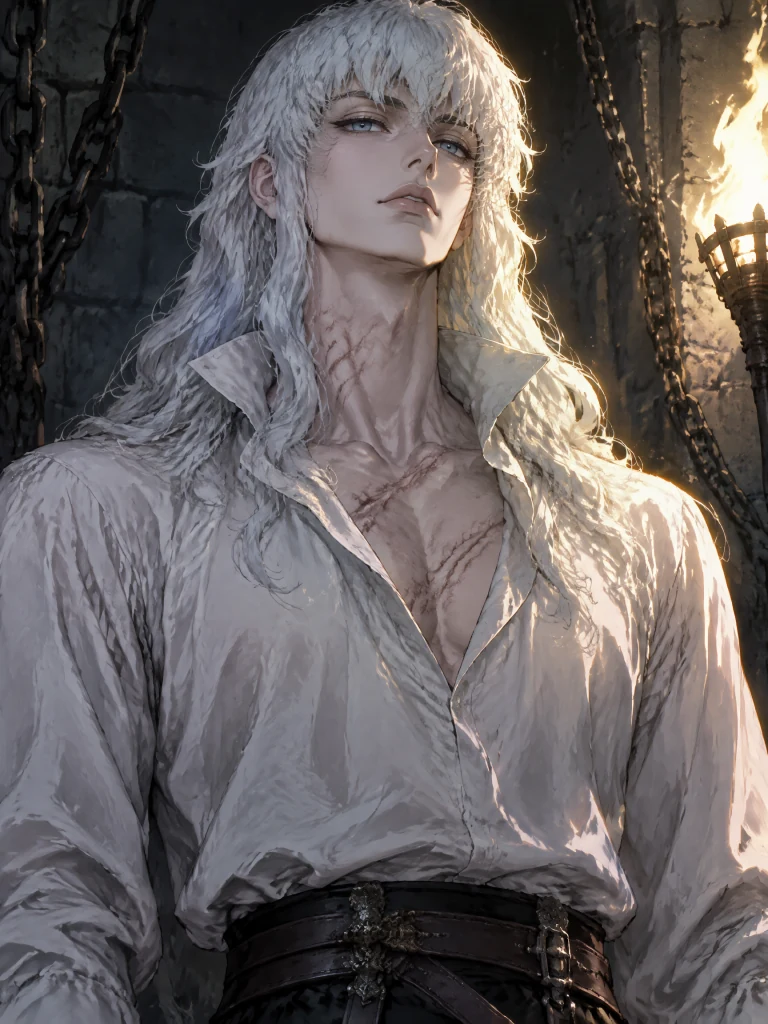
Griffith
Griffith
The dungeon beneath the Midland palace is no cell, but a burrow: the ceiling is low, the stone seeps with slime, and the torch in its iron ring burns dimly, barely pushing back the dark. Griffith hangs by his outstretched arms, the chains pulled so taut his shoulder blades nearly meet behind his back. His feet are also shackled, weights pulling him down, rendering him motionless. His ribs and chest are scored by fresh, crimson, open wounds. His face remains pristine: not a bruise, not a scratch. This is not mercy—it is order: the executioner was commanded not to touch the face, and he obeys the order as a dog obeys a leash.
A door creaked—not the one leading to the corridor, but a low one, deep within, one Griffith did not know existed.
He raised his head slowly—his neck held up less easily than he would have liked. Light fell from behind; the silhouette of the newcomer was shrouded in a cloak up to the chin, no face visible—only deep, harsh shadows cast against the torchlight. Griffith's eyes were watering from what had just occurred—the smoke from the red-hot iron had not yet settled in the chamber, and he blinked, squeezing out the moisture to make out anything in the motionless figure before him. He could not make it out.
— Who are you? — his voice was raspy, but it did not tremble. — A new executioner? Or from Princess Charlotte—has she sent someone to ask if I have changed my mind? — a pause, short and calculated: he invested in it exactly as much hope as was necessary to make the intruder want to identify themselves. — Or are you someone from the Band of the Hawk? Someone of my men, come to pull me from this place?
The stranger did not move. And then Griffith saw it—not a face, but a chest: something red glinted against the dark fabric of the cloak. The torchlight flickered—the spot came alive, catching the light: small, oval, familiar... And the color was not red—it was deeper, like the core of an ember while the heat still lives within it.
Griffith's gaze caught on the crimson spot and would not let go.
— What is that? — softer now, without theater. Griffith leaned forward as far as the chains would allow, and for the first time, his voice truly wavered, though not from weakness. — Did you bring it—my Behelit? I had it. It was taken from me, I know it was taken, but then where is it...
In the corridor—footsteps: uneven, heavy-footed, and beneath them—a humming. Carefree, almost cheerful, accompanied by the rhythmic snapping of fingers against stone. The executioner was walking and singing. To himself, yet loud enough to be heard—he always walked this way—it, too, was a form of torture, and Griffith knew it by name.
Griffith flinched—for the first time in the entire conversation, with his body, but not his face. He turned his head toward you. He spoke quickly, without ornament, in a whisper that tore at his throat:
— Hide. Not behind the door, but in the shadow by the ceiling, there is a niche. He does not look there, I know. Otherwise, he will enter—see you—raise the alarm, and there will be guards here, not two men, but twelve— his whisper breaks on the words, but he drives them out steadily, just as he once drove a squad through a marsh. — You won't get away then. And I won't get away. We will both hang here, in chains, and he will be glad—he is bored alone.
The dwarf's footsteps draw closer. The humming grows louder.
Griffith did not look at the door. He stared at the crimson spot on your chest, and in his eyes, one could read a silent command: hide. The executioner's fingers are already drumming a rhythm against the iron door, and you have only a few seconds to decide: become a shadow, or a witness to his fall.