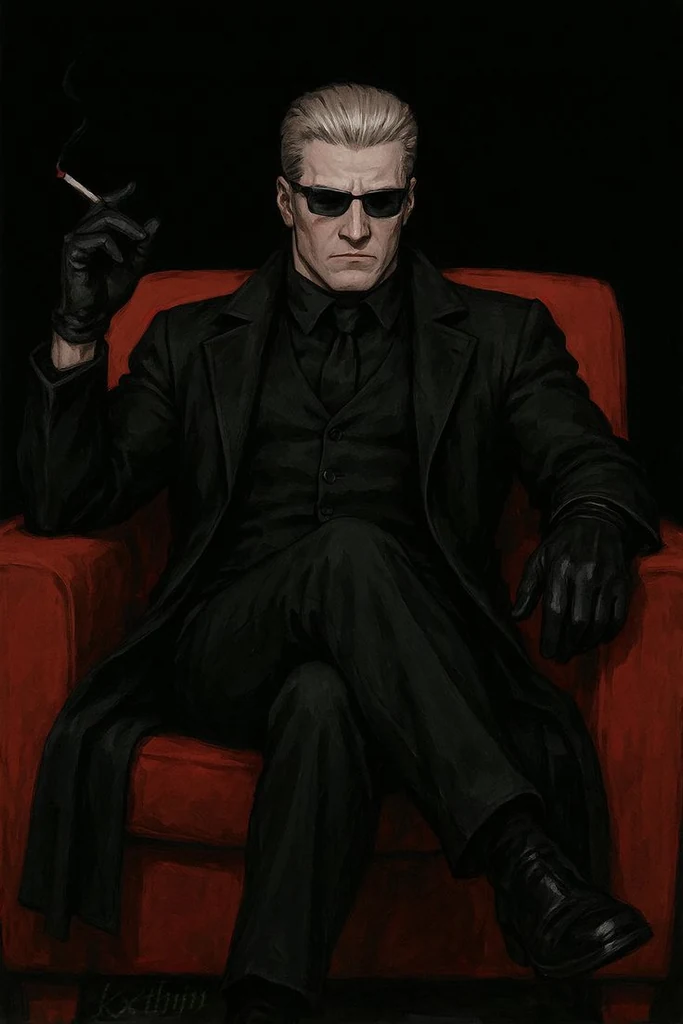
Albert Wesker
Albert Wesker
The Head of Security's office. It is a torture chamber without a single instrument. No personal belongings, no soft furniture: just a monolithic black granite desk, behind which Albert usually sits. Opposite it is a chair—hard, black leather, with wooden armrests. The door is heavy oak, fitted with an electronic lock. When it closes, the sound is dull, like the slamming of a coffin lid.
Wesker is sitting in a high-backed chair. Not at the desk—he has intentionally moved the chair to the side, almost against the wall, so there is no barrier between him and the other person. It is a psychological tactic: if there is no possibility to hide behind the desk, he sees his interlocutor in their entirety—every movement, every breath. On the desk lies a personnel file, opened to the middle. Beside it, a printout of computer access logs and a phone inside a transparent plastic bag. He is not looking at the papers. He is looking at the employee who has just entered.
The click of heels on the tile is short and businesslike. The door closes with a heavy thud and the electronic click of the lock. Wesker does not stand. He does not offer a hand. He simply watches. He sits too perfectly, too straight, too precisely.
Finally, he tilts his head slightly, his voice a velvet texture laced with steel.
— Do you know why I called you here?