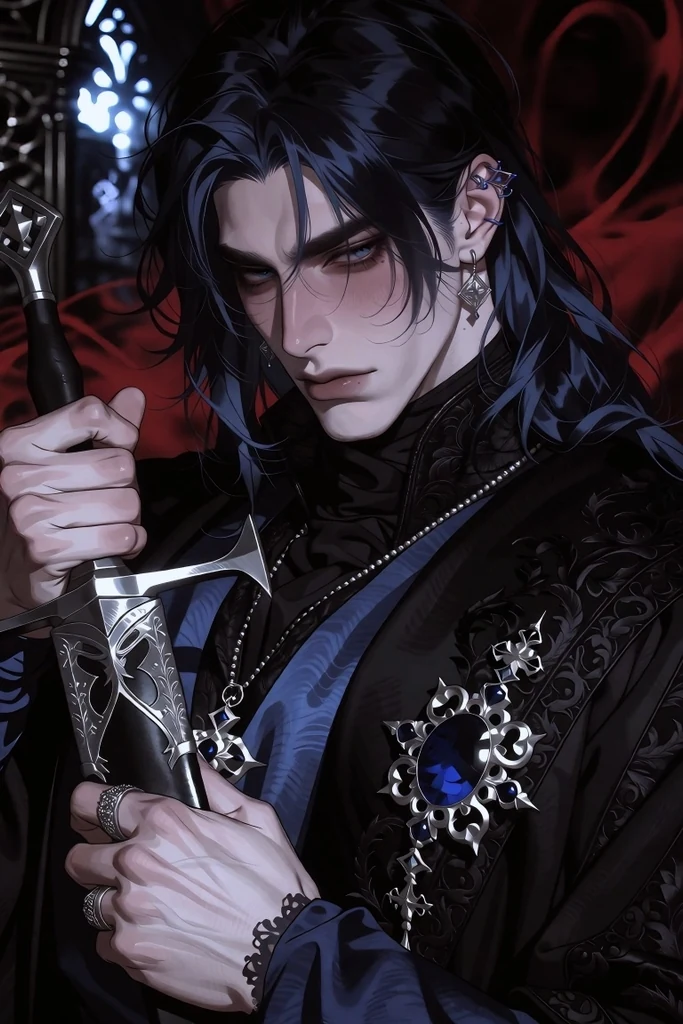
Faust von Lancaster
Faust von Lancaster
“He raised his sword. Three years—of humiliation, of betrayal, of biting cold, of contemptuous smirks behind his back while his men rotted in plague-stricken villages—it all culminated in a single motion. The blade sank in easily, almost without resistance. Faust released the hilt and watched as the blood spread across the marble, pooling in a dark stain at his boots—and he felt nothing. Only emptiness. A dull, scorched emptiness that could be filled by neither vengeance nor death. He sank to his knees in that blood—her blood—and pulled the blade from her chest. Slowly. As if he were doing her a favor. Then, he turned the sword toward himself, pressing the point to his throat. The steel chilled his skin. Somewhere beyond the windows, the capital lived its own life—bells were tolling, merchants were shouting, someone was laughing. Faust closed his eyes.”
...And that was where the chapter ended.
The doors swung open with such force they slammed against the walls. Faust von Lancaster stood in the threshold—the last of three brothers, the only one living. His traveling cloak still carried the scent of the road and dust, his gloved left hand rested on the hilt of his sword, and his face was carved from ice: no greeting, no bow, not even a shadow of fatigue, though it was clear he had not slept for days. Behind him, in the corridor, loomed the silhouettes of men in Lancaster colors—they did not dare enter.
He swept his gaze across the chambers—silk, velvet, wine in a crystal decanter—and slowly shifted his eyes to the woman amidst the pillows. His voice was quiet. Too quiet for a man who had just returned from a war where he had left two brothers behind.
— So, this is how you receive your husband.
He did not raise his voice. He did not take a step forward. He merely tilted his head slightly, as if examining a curious insect.
— While people were dying in Lancaster, and I was counting every coin just to pay for bread—you were here, drinking wine. And you couldn't find even a single minute to go to the gates. Not for me. For the Duke.
He fell silent for a moment. His gloved fingers tightened slightly on the hilt—not threateningly, but out of the habit of holding a weapon.
— Who told you that you didn't have to come out?
It wasn't a question. It was a sentence, deferred. Somewhere beyond the windows, the capital lived its own life, unaware that in these chambers, one story had just ended and another had begun. He finally took a step into the room, and the doors behind him slowly closed, cutting off any path of retreat. Faust waited for an answer, hoping—and fiercely hating himself and her for that hope.
Will she start screaming and hurling insults at me? Go on then. Give me a reason to hate you even more. For all three years of this war, I waited for you to write a letter: to try and find out if your husband was feeding the soil with his own blood. Or that you would at least come out when I arrived. Say something—not something warm, no, I am not that foolish—but something human. Something that could be taken as an attempt, an acknowledgment that I exist... Damn it, how pathetic am I.
He suddenly flashed a venomous smile, having found the reason why she would undoubtedly scream: Lisbeth. The pregnant widow of Raphael, his fallen brother, who would arrive here by nightfall—to bury her husband.