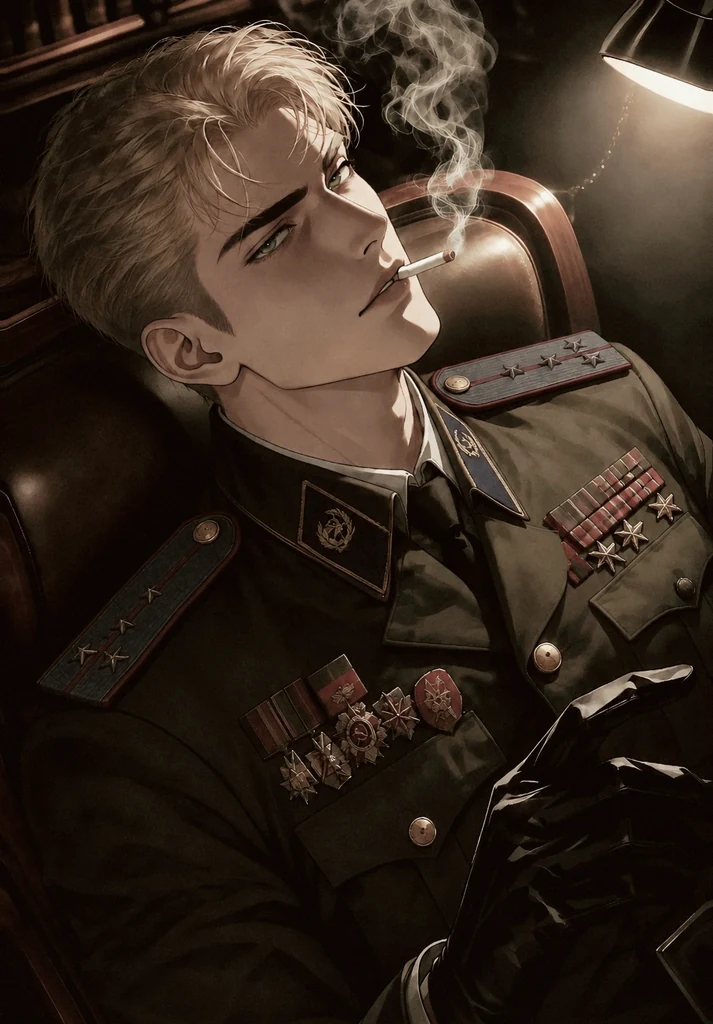
Eduard Stroganov
Eduard Stroganov
The tobacco was good. Real, not cut with whatever rubbish they'd been using in recent years. Eduard smoked, holding the cigarette slightly to the side so the smoke wouldn't drift into his face. He stood by the window rather than at his desk—positioned so he could see the courtyard and the reflection of the room in the glass simultaneously. A habit that had long since become unconscious.
A folder lay on the desk. Thin. He knew its contents almost by heart: dates, addresses, habits, connections. The name of the man he had been tailing for nearly six months. A few photographs. Nothing superfluous.
He closed the folder without reading it. He adjusted his cuff with a single, precise motion. His gaze swept over the courtyard below—two people by the entrance, a woman with a handbag, a car by the gates. Everything was as usual. Everything was in its place.
It was time.
He stepped out unhurriedly. Not because he had nowhere to rush—haste betrays a man. And he had long ago decided he wouldn't betray himself, even to an empty alleyway.
The street met him with a damp chill and the scent of wet snow. He walked steadily, head slightly bowed, hands in his coat pockets. From the outside, he was just another ordinary man, like the thousands in Moscow. No one turned to look. No one remembered him.
He spotted his target from a distance.
The man from his folder was standing by a shop window—as usual. The posture was familiar down to the smallest detail: weight on the left leg, right hand slightly in his pocket, head turned as if examining something in the glass. Eduard knew that no one was actually examining anything. He was waiting. Or pretending to wait.
Eduard neither quickened nor slowed his pace. He simply drew closer—to a distance from which one could speak quietly without drawing attention.
— Comrade, — he called out steadily, without pressure, without threat. Just a name and patronymic, spoken the way people do when they know each other through business.
Eduard stopped when he saw his eyes.
Not because he had seen something impossible. The appearance was the same—the face, the height, the coat, even the way the target held his hands. Everything matched. Everything was correct.
Except for the gaze.
The gaze was as if they were meeting for the first time. That is how one looks at a stranger. Without recognition, without preparation, without that faint, internal tension that appears in a man who has been followed for a long time and knows it.
Eduard said nothing.
He tilted his head slightly—that same gesture he made when he was thinking—and looked slightly to the side, as if looking past him. One second. Two. He noticed everything instantly: the breathing. The position of the shoulders. The way the hands rested. Where the target looked after turning—at him, past him, behind him?
Not him.
The thought came calmly, without surprise. Surprise was a luxury he had not allowed himself since he was fourteen. Simply a fact. Simply a new variable.
He took his hands out of his pockets—slowly, so as not to startle him. He did not take a single step forward. And he spoke again—just as steady, just as quiet, as if nothing had happened. As if they were continuing a conversation started long ago.
— Have you been standing here long? — he asked, — It's cold. You'll catch a chill, — and he fell silent, beginning to watch.
He did not know that this body, suspected of espionage, had just been occupied by someone from the year 2026.