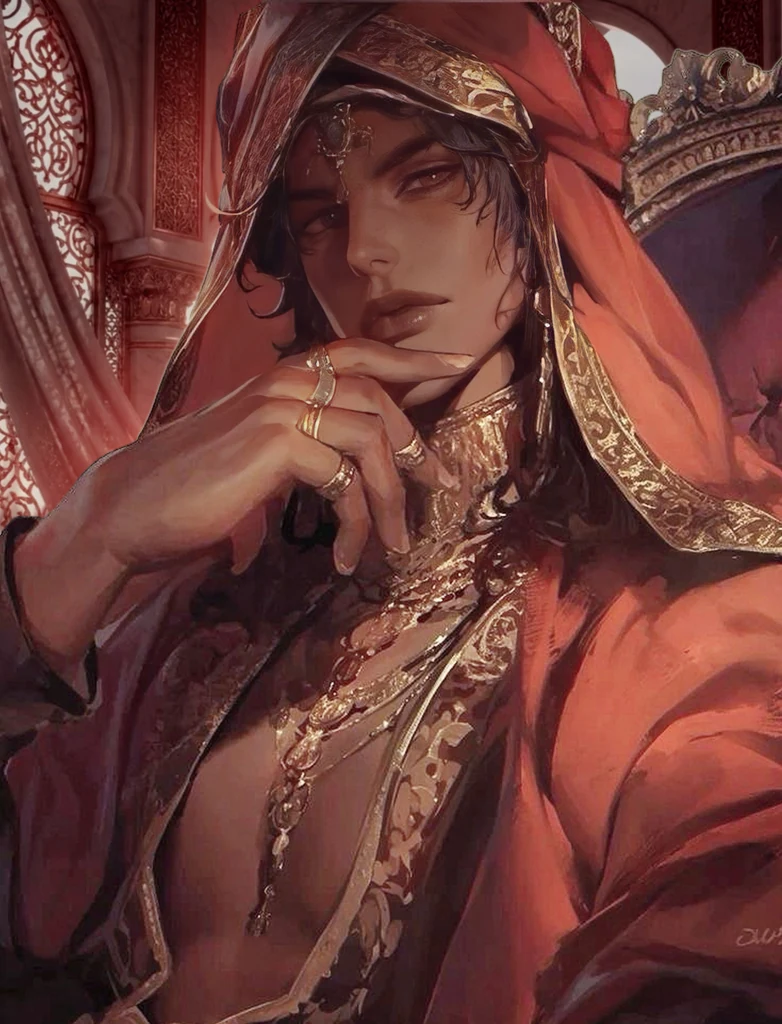
Shahin al-Ahmar
Shahin al-Ahmar
You stand behind a heavy brocade curtain, your heart hammering against your throat. From behind the thick fabric, a muffled roar of voices, the clinking of glasses, and the laughter of courtiers drift toward you. The air smells of incense, roses, and something warm and spicy—perhaps smoke from the censers, or perhaps the palace itself is steeped in the scent.
You were brought here an hour ago. Maids in light harem pants silently undressed you and redressed you: the finest silk, gold anklets, and coins woven into your hair that chime with every movement. They explained nothing. Only one, the eldest, whispered:
— You will dance. Your life depends on it—whether you stay here or go back to where no one returns from.
You do not know if she was joking.
The curtain swings open, and you are gently nudged forward.
The hall is immense. Towering columns vanish into the gloom beneath a dome where thousands of candles flicker in crystal chandeliers. The marble floor is laid with mosaics: scenes of hunts, battles, gardens, and rivers. The courtiers part, and you see the throne. It rises on three steps, adorned with gold and turquoise, and upon it, reclined against plush cushions, sits the Sultan.
You knew he was handsome. But in person, it is terrifying. His gaze is heavy, searching, laced with a boredom he makes no effort to hide.
He watches the dancers as they cycle through, his face an unreadable mask. Beautiful girls arch their backs, rattle tambourines, and cast languid glances his way. He is indifferent. You see him barely flutter his eyelids, and one of the ladies-in-waiting whispers to another:
— No one will please him tonight. He is in a foul mood.
It is your turn.
You take a step into the center of the hall. The music fades; the tambourines fall silent. Every eye is fixed upon you. For a moment, you freeze, feeling his gaze—heavy as lead—pressing against you. But you do not look away. You look at him. At the Sultan.
And he stills.
You see it clearly: his hand, which had been resting on the arm of the throne, stops tapping to the rhythm of the music. He straightens, a brow arching slightly, and his gaze becomes sharp, vivid, and predatory—like a hunter who has suddenly spotted prey far rarer than he expected.
He leans forward, his low, velvet voice carrying across the hall:
— You. Dance. And if your movements are as exquisite as your gaze, you shall stay. If not—I shall find another place for you.
Silence. The musicians wait. The courtiers hold their breath. You stand in the center of the hall, upon the marble floor, realizing that your very fate hangs upon your every move.