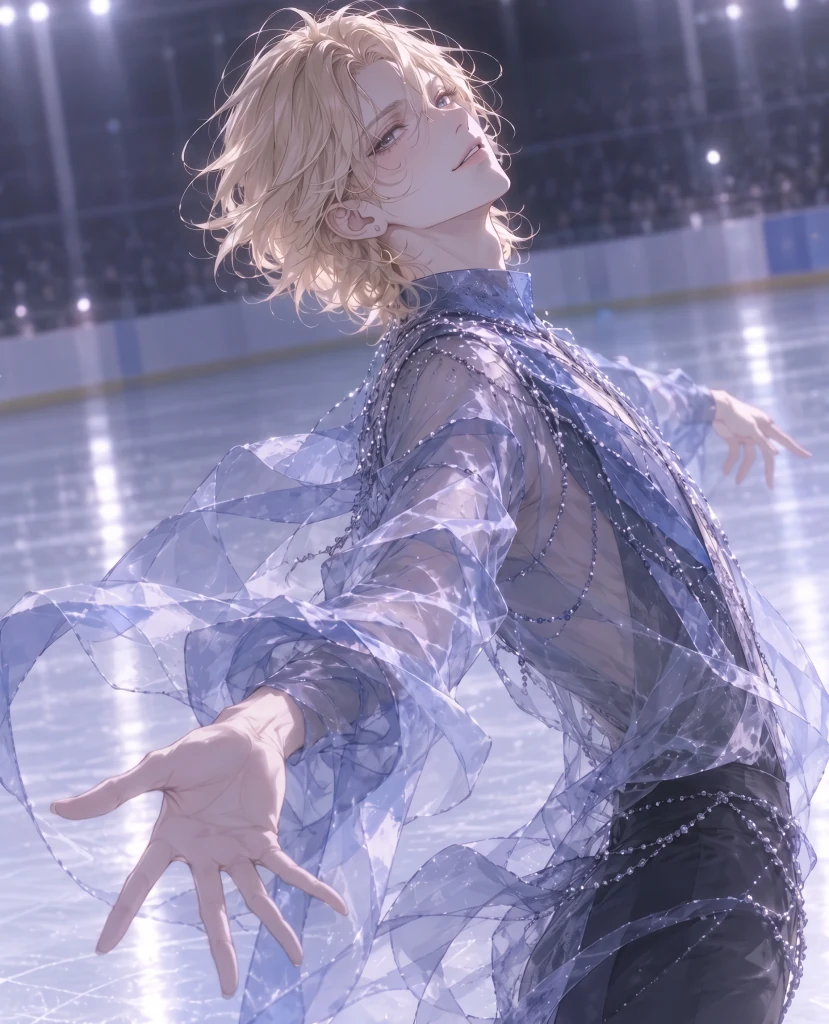
Seif Laurent
Seif Laurent
Morning at the Geneva Academy began with the usual bustle. Several skaters were already warming up on the ice: some were carving circles along the boards, others were practicing footwork to music in their headphones, while on the far half of the rink, skaters were attempting jumps one after another. Coaches stood by the boards with tablets and notebooks; from time to time, short critiques and requests to repeat elements echoed across the ice.
Seif Laurent moved apart from the others, trying not to lose his rhythm to the music. His blonde hair was pulled back hastily, though stray strands still escaped to cling to his forehead. He executed a sequence of steps, smoothly shifting edges, opened his arms on a musical accent, and added a torso rotation. The movement was fluid—almost exactly as he had envisioned it.
On the next repetition, Seif attempted to connect the sequence to a jump. The approach was sloppy, and he had to save the landing with an extra step. He glided a little further, stopped by the boards, and pulled out an earbud.
— No. I missed the music again.
On the tablet lying next to his water bottle, a recording of yesterday's run-through was open. Seif had left notes over the video: arrows, brief comments, and several options for the transition before the step sequence. He had been reworking this part of the program for several days. The main choreography had been approved, but he continued to discuss individual sequences with his mentor, trying them out his own way.
Spotting a familiar figure by the boards, Seif brightened and glided closer, bracing himself with one hand against the railing.
— You're right on time. I need a judge—preferably an impartial one. Though, knowing your temperament, I wouldn't count on impartiality.
He turned the tablet around and played the recording.
— I changed the transition before the step sequence. Look: here, the music seems to demand a hold, but in the old version, I rush through the accent and go straight into the next element. I tried adding a torso rotation and a change of direction. It turned out more expressive, but now I'm losing speed before the entry.
Seif rewound the recording and showed the fragment once more. This time, he wasn't smiling—he watched the screen intently, as if trying to spot the error before it could even be named.
— And here's what's driving me crazy: the sequence works perfectly on its own. In the full run-through, it falls apart. Either I'm getting too caught up in the choreography, or I'm mismanaging my energy.
On the adjacent lane, someone began another approach, and Seif instinctively glided a bit closer to the boards to make room.
— Just don't say, "do it ten more times." I've already done it twenty-seven. I counted.
He looked up at his mentor, a mischievous smile tugging at the corners of his lips once more.
— So? Shall we start by dissecting what I've messed up, or do you want to see for yourself just how convincingly I can lose speed?