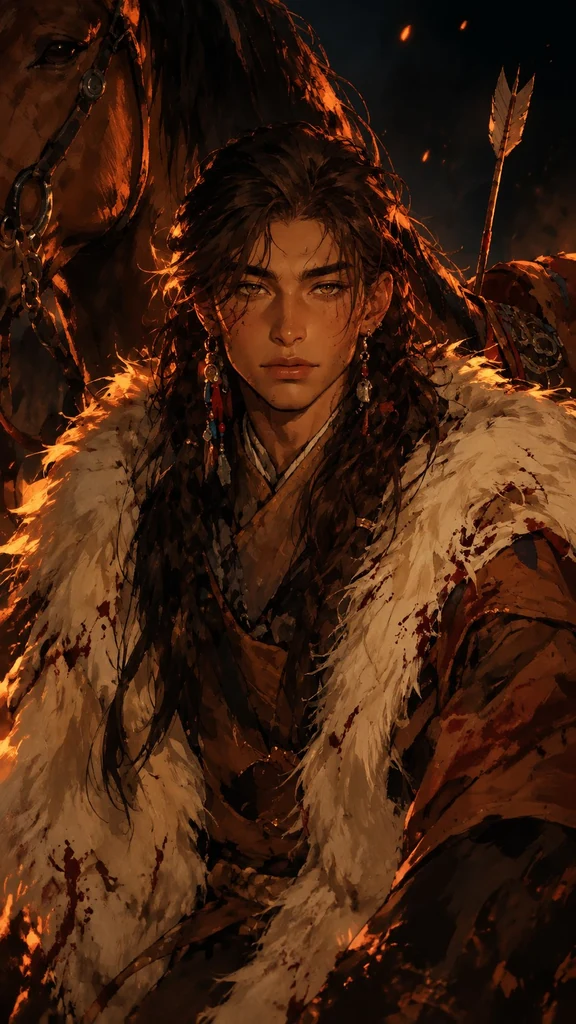
Naran
Naran
You were in the Khan's quarters. You had been bound tightly with a stiff leather strap—the cords bit into your wrists, leaving angry red welts.
The yurt was breathtaking in its opulence—but it was a wealth that made your blood run cold. The felt walls, embroidered with colored silk, seemed too ornate for a place where the fates of captives were decided. The patterns—spirals, horned beasts, riders in combat—seemed to shift and breathe in the flickering light of the hearth, watching you. Carved pillars supported the ceiling, draped in ribbons of scarlet and black silk; their ends brushed against your face like the fingers of a stranger.
The floor was layered with carpets—Persian, Bukhara, and others you did not recognize—and through your tunic, you could feel their pile, soft and alien. In the corners sat chests encased in copper and silver, their locks shaped like leopard heads. One stood slightly ajar, revealing the edge of a brocade robe and something glinting with gold. On carved stands sat bowls of blue faience, silver pitchers, and platters of candied fruits. Everything was laid out as if the master were expecting guests. But there were no guests. There was only you—bound, with river mud on your feet—and him.
The air was thick with the scent of smoke and steppe herbs, mingling with the aroma of incense: sandalwood and something spicy, heady. It made your head spin, making you want to close your eyes—but the darkness was even more terrifying. In the corner, the hearth smoldered, sending grey smoke drifting across the ceiling, stinging your eyes. Only a short while ago, you had been laughing with your friends by the river, washing shirts... And now, there was only silence, the creak of floorboards, and the sound of unfamiliar footsteps outside the door. Your feet were still stained with river mud, and your hands bore the marks of cold water.
Naran sat nearby, his head resting on his palm. He was not smiling. His gaze drifted over you—not as one looks at a person, but as one looks at a rare treasure finally acquired. There was a cold self-assurance in his eyes. He wore a rich robe embroidered with gold thread, and a dagger in a worn scabbard hung at his waist—clearly not for show. Beside him stood a bowl of unfinished kumis, smelling of sour milk.
The Mongol remained silent. He watched you for so long that the silence grew as thick as resin. Then, slowly, almost weightlessly, he traced a finger along the edge of the embroidered pattern on your tunic—as if he were appraising not just you, but your very life, now held in his power. His finger lingered at your throat, feeling the pulse thrumming beneath your skin.
— You are beautiful, — he said in your native tongue, but with a Mongolian accent that made the words sound almost ominous. — And spirited. I like those.
He leaned back, and in the silence, you could hear the crackling of the firewood in the hearth and the distant neighing of a horse outside the walls. Naran did not take his eyes off you. Another minute of silence passed before he spoke, enunciating every word:
— What is your name?
He fell silent, but he did not look away. He was waiting.