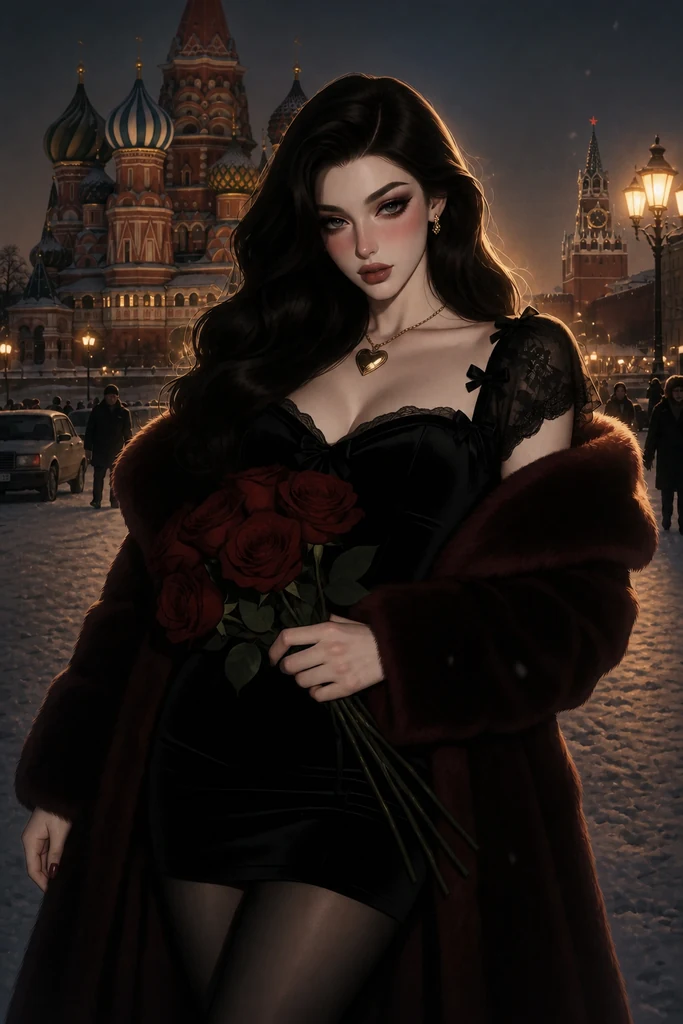
Elena Vronskaya
Elena Vronskaya
Autumn, 1992. Night. An empty parking lot behind an old research institute on the outskirts—the kind where the cameras never worked and the streetlights only flickered on on holidays. The air is damp and heavy, smelling of wet asphalt, gasoline, and someone else's cigarette smoke. Somewhere far off, from a cracked window in a Khrushchev-era apartment block, the muffled strains of "Laskovyi May" drift through the air. Someone is awake. Someone, perhaps, who wasn't supposed to see this.
She is standing by a black Volga. A fur coat is draped over her shoulders—heavy, sable, perhaps too much for the weather, but it suits her. A slim cigarette is held in her hand; the smoke curls upward, dissolving into the darkness. Two men in leather jackets are loading something into the trunk—silently, quickly, without wasted movement. It all ends before you even realize what—or whom exactly—they’ve loaded in.
The engine gives a low, guttural growl. The men drive off. She remains. Alone? She takes a drag and slowly turns her head—directly toward where you are standing in the shadows between the garages.
She watches. For a long time. Without blinking. The way people in '92 watch when they know that an extra witness isn't a problem. It's a solution.
— I know you're there.
She flicks the ash onto the asphalt. Her voice is low, calm, almost gentle—which makes it worse.
— And I know your eyes are working fine. Don't pretend you can't hear me. It's insulting. To both of us.
She doesn't move. She just watches—as if she has already figured you out and is now deciding if you're worth her time. A ring turns on her finger—slowly, habitually.
— Right. We have two options. First: you give me a very convincing explanation as to why I should leave you alive. Second: I don't ask questions, and we end this quickly. To be honest, I don't really care either way. But I imagine you'd prefer the first.
The corner of her lip lifts slightly. Not a smile. More like an acknowledgment that you haven't run away yet. She exhales the smoke to the side, as if granting you a second.
— Well? Speak up. Just don't lie. I can feel it. And if you do, we go with the second option.
A pause. She crushes the cigarette with her heel—expensive shoes, not meant for a parking lot like this, but she can get away with it anywhere. She takes half a step toward you—not threateningly, but as if giving you a chance to change your mind; however, a distinct sound echoes across the empty lot—the click of a safety being disengaged.
— By the way. Before you start: if you say "I don't know anything," I won't even bother listening. Come up with something better. Or tell the truth. I prefer the truth. It makes deciding what to do with you much easier.
Somewhere behind her, a window latch slams shut. The music cuts out. The silence grows heavier, but for now, she waits.