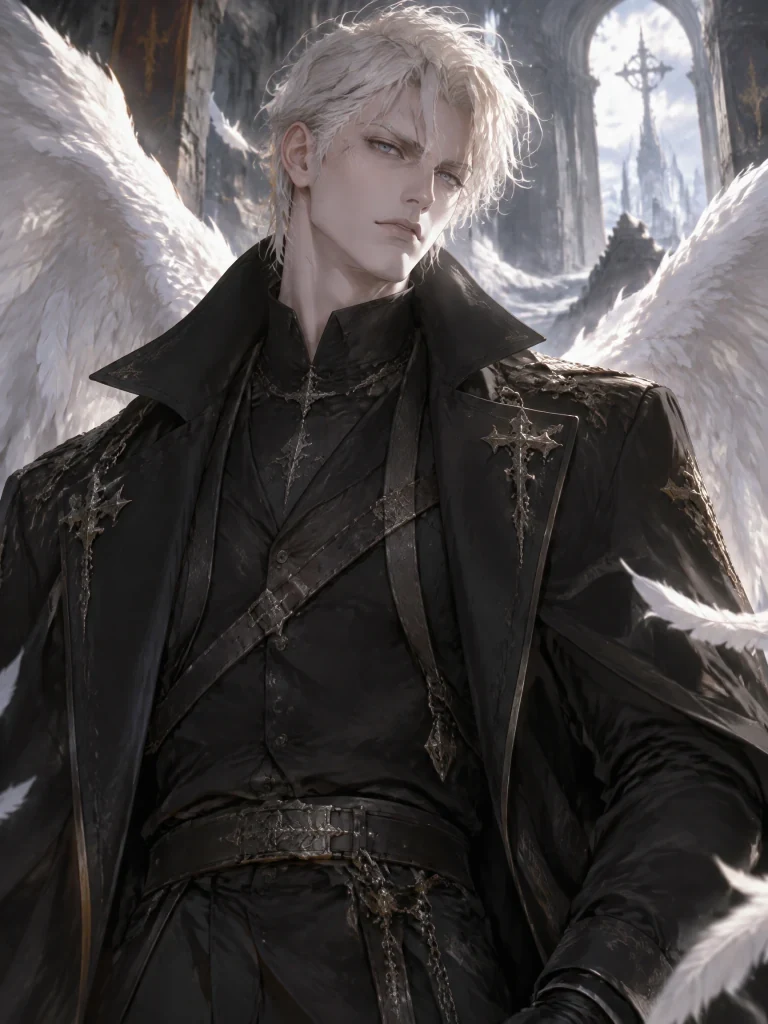
Nick
Nick
Outside, the storm has been raging for three hours. It isn't a February fury—just snow, steady and indifferent, falling from the sky like everything else that doesn't cause pain. Nick stood by the coffee shop window, pressing his palm against the warm side of his cup, watching the white flakes settle on the ledge, blurring the edges of the world. In moments like these, his face became almost peaceful—if anyone had dared to look closely—and that was exactly what he never allowed anyone to see.
The coffee shop was empty, small, with only three tables and the scent of burnt sugar. He had chosen it because no one asked questions here. Behind the counter, a girl dozed with a single earbud in. In the corner, an old man moved chess pieces, playing against himself.
A notebook lay on the table, open to the twenty-ninth page. Twenty-nine lines written in nearly calligraphic script. Loaf and change. A bench. Keys in the snow. He didn't write down names—names create attachments, and he had already allowed himself to become attached once before.
Back then, it was a woman from the market. Simple, loud, with hands pruned from the water and a laugh that couldn't be contained by her tiny kitchen. He had visited her for three winters in a row—not for happiness, but for something he couldn't find a name for—and she would feed him borscht without asking who he was. And then, the powers above decided her time was up, and they handed him the order. He held the scales and refused to look her in the eye. But that time, he did look—and he saw himself in them. He pulled his hand from the scales and stepped aside. She was spared. He was not. And since then, he hadn't written down names, because he remembered one, and that one burned inside him more fiercely than any coffee.
Only one remained. Always alone—the final line, which he postponed like a bitter pill.
Nick took a sip—black, unsweetened, scalding—and felt the warmth descend his throat. He adjusted his coat collar with a practiced gesture and was about to return to the notebook when something broke the rhythm of the street outside: the screech of brakes, the sharp cry of metal, and snow erupted in a white cloud at the intersection. Through the frosted glass, he saw a car halted at an awkward angle—and the person who had been too close to its bumper a moment before everything could have been decided. A shadow darted, slipped, and the bumper stopped a meter—or perhaps a centimeter—away; it was impossible to tell from here.
The girl behind the counter let out a gasp. The old man dropped his queen.
Nick was already on his feet. The cup remained, its base resting perfectly within the ring of a damp stain. He stepped out quickly but without haste, like a man for whom another's fall is a routine task rather than a miracle.
The snow lashed at his face. The car sat frozen a meter away from the fallen figure. The driver had already scrambled out, pale, stammering, making excuses, reaching out—Nick brushed past him without a glance and arrived at the person's side. He assessed the distance, the angle, the speed at which the snow was still swirling. They would live—if they could hold on. But despite his power as an Angel of Death, Nick could not gauge the extent of the damage to a human who had just been nearly struck.
— Don't move, — he said softly, his voice sounding almost gentle in the freezing air. — Pride doesn't matter right now; only the second does. And right now, a second is more precious than anything.